I like Swan Point. It is one of the prettiest places in Providence: thousands of trees, two ponds, almost a mile of Seekonk River shoreline, and a western half planned by the Olmsted firm. It is also 199 acres of the most valuable land in the state. The city assesses it at $235.6 million. It pays no property tax. Its roughly 40,000 residents are dead, and most of them have been dead for a very long time.
The city never promised them that land forever. The state did: Swan Point's 1858 charter says its property "shall be forever exempt from all taxes." But in 1844 the legislature gave itself the right to amend or repeal any charter it granted from then on. I think it should use that right, slowly and carefully, so that old cemetery land comes back to the people who are still alive to use it.
What the dead cost Providence
Rhode Island law exempts "lots of land exclusively for burial grounds" from property tax, and Swan Point's charter goes further, exempting "all the property of this corporation." If Swan Point paid the commercial rate like any other large landholder, its bill would be about $6.9 million a year. At the residential rate for a rental house, about $3.4 million.
Put that next to the schools. This spring Providence's public schools faced a $16.5 million deficit and warned they could lay off 109 people, including 67 teachers. Swan Point's tax bill alone would close 42% of that gap. It would cover the base pay of all 67 teachers, even if every one of them were at the top of the pay scale. It equals 4.5% of the $152 million the city puts into its schools each year. Statewide, the exemption on private and church cemetery land costs Rhode Island's cities and towns an estimated $10 million to $21 million a year, and more than half of it sits in Providence.
Swan Point's tax bill could cover the base pay of all 67 teachers facing layoff
Millions of dollars a year
The land matters more than the money.
- Swan Point is 1.7% of the city's land. Add North Burial Ground and the smaller grounds and cemeteries cover about 345 acres, nearly 3% of Providence.
- Swan Point alone is about a sixth the size of the city's entire park system.
- Each grave at Swan Point holds about 217 square feet of the East Side. Each living Providence resident has about 244 square feet of public park.
Land per person, drawn to scale
Each square is the area one person gets
It is beautiful, but it is not a park. The rules ban dogs, picnics, skateboards and earphones. Jogging is allowed from 8 to 9 in the morning. The gates close at 5pm from October through March. Photographing gravestones is not allowed.
Meanwhile Providence permitted 778 new homes in all of 2025. Almost half of the city's renters are cost-burdened. The median home value is up 61% since 2020.
We have done this before
Swan Point itself is built partly from moved graves. In 1848 the First Congregational Society moved its downtown burying ground there, 660 adults and 327 children. Between 1859 and 1882 Swan Point took in the remains from the West Burial Ground. By 1946 about 4,000 of its 27,134 burials had come from older grounds. Starting that same year, Swan Point sold its own land west of Blackstone Boulevard as house lots. Its lot rules still say a lot "will not be sold until all interred remains have been removed."
San Francisco banned burials in 1900. As Colma's own town history puts it, the land "was too valuable to be wasted on the cemeteries." The Supreme Court upheld the ban, and by the 1940s the city had moved nearly 150,000 bodies to Colma. Colma now has 1,509 living residents and 1.5 million dead. Lincoln Park and the Legion of Honor sit on the old City Cemetery.
Washington Square Park was a potter's field with an estimated 20,000 burials, and they are still there. Madison Square Park and Bryant Park were burial grounds too. Chicago's Lincoln Park was the city cemetery. Hart Island, where New York buried more than a million people, moved to the Parks Department in 2021 and opened to public tours in 2023. Nobody picnicking in Washington Square feels like they are robbing a grave.
Moving the dead for the living, 1785 to now
Some of it done badly, some done well
- 1785
Paris closes its central cemetery, the Innocents, for public health and moves the remains to what becomes the Catacombs.
- 1797–1825
Washington Square serves as a potter's field. An estimated 20,000 burials remain under the park.
- 1844
Rhode Island reserves the right to amend or repeal any corporate charter it grants from then on.
- 1848–1882
Swan Point takes in graves moved from older Providence burial grounds, about 4,000 people by 1946.
- 1858
Swan Point's new charter declares its property "forever exempt from all taxes and assessments."
- 1866
Chicago closes City Cemetery. The land becomes Lincoln Park.
- 1900
San Francisco bans burials, then moves nearly 150,000 bodies to Colma.
- 1946
Swan Point starts selling its land west of Blackstone Boulevard as house lots.
- 1964The wrong way
Providence moves 4,355 North Burial Ground graves for I-95, mostly from the "free grounds" for the poor and people of color. Most go into a mass lot. Records for about three quarters are never kept.
- 1998
Singapore limits graves to 15 years. Bidadari's roughly 147,000 graves later make way for 8,872 public homes and a park.
- 2006
Berlin releases 290 of its 1,037 hectares of cemetery land for other uses.
- 2007
London allows grave reuse after 75 years.
- 2021
Hart Island moves to NYC Parks. Public tours begin in 2023.
- 2023The right way
HS2 reburies more than 14,000 people from St James's Gardens, Euston, at Brookwood Cemetery, in consecrated ground, with a memorial.
- 2026
England's Law Commission recommends allowing grave reuse nationwide after 100 years.
Most of the world rents graves
The American idea of a grave as permanent private property is unusual.
How long a grave lasts elsewhere
Terms set by law or common practice
| Place | How long | What happens next |
|---|---|---|
| Germany | 20–25 yrs | The grave is reused unless renewed. Some towns bill by the year: Bastheim, Bavaria charges €60 a year per grave. |
| Sweden | 25 yrs | Free, paid for by a burial fee of about 0.29% of income. Renewable. |
| Netherlands | 10 yrs min. | Renew or release. |
| Greece | ~3 yrs | Bones move to a rented ossuary box, about €50 a year. |
| Singapore | 15 yrs | Remains are cremated, or reburied in a smaller plot where faith requires burial. |
| Hong Kong | 6 yrs | Public graves are cleared; unclaimed remains are cremated. New niches are leased for 20 years. |
| London | 75+ yrs | Old graves may be reused. Remains are reburied deeper in the same grave. |
| New South Wales | 25–99 yrs | Renewable rights since 2018. Remains go in an ossuary box. |
Two results stand out. Berlin's 2006 cemetery plan released 290 of its 1,037 hectares of cemetery land, 28%, for other uses. Singapore cleared Bidadari, a cemetery of about 147,000 graves, and built 8,872 public homes around a 25-acre park, with a memorial garden that keeps notable headstones. In March 2026, England's Law Commission recommended allowing grave reuse across the country after 100 years.
The plan: the 75-year rule
End the exemption, slowly.
Tax cemetery land like any other land, phased in over ten years.
75 years free.
Land under graves younger than 75 years stays tax-free. That covers everyone whose children and grandchildren still visit. London uses the same 75-year line.
Pay to stay.
After 75 years, anyone can keep a grave where it is by paying its share of the tax. At Swan Point that is about $170 a year. Families, churches, historical societies and Lovecraft's fans can all keep the graves they care about.
Move the rest with care.
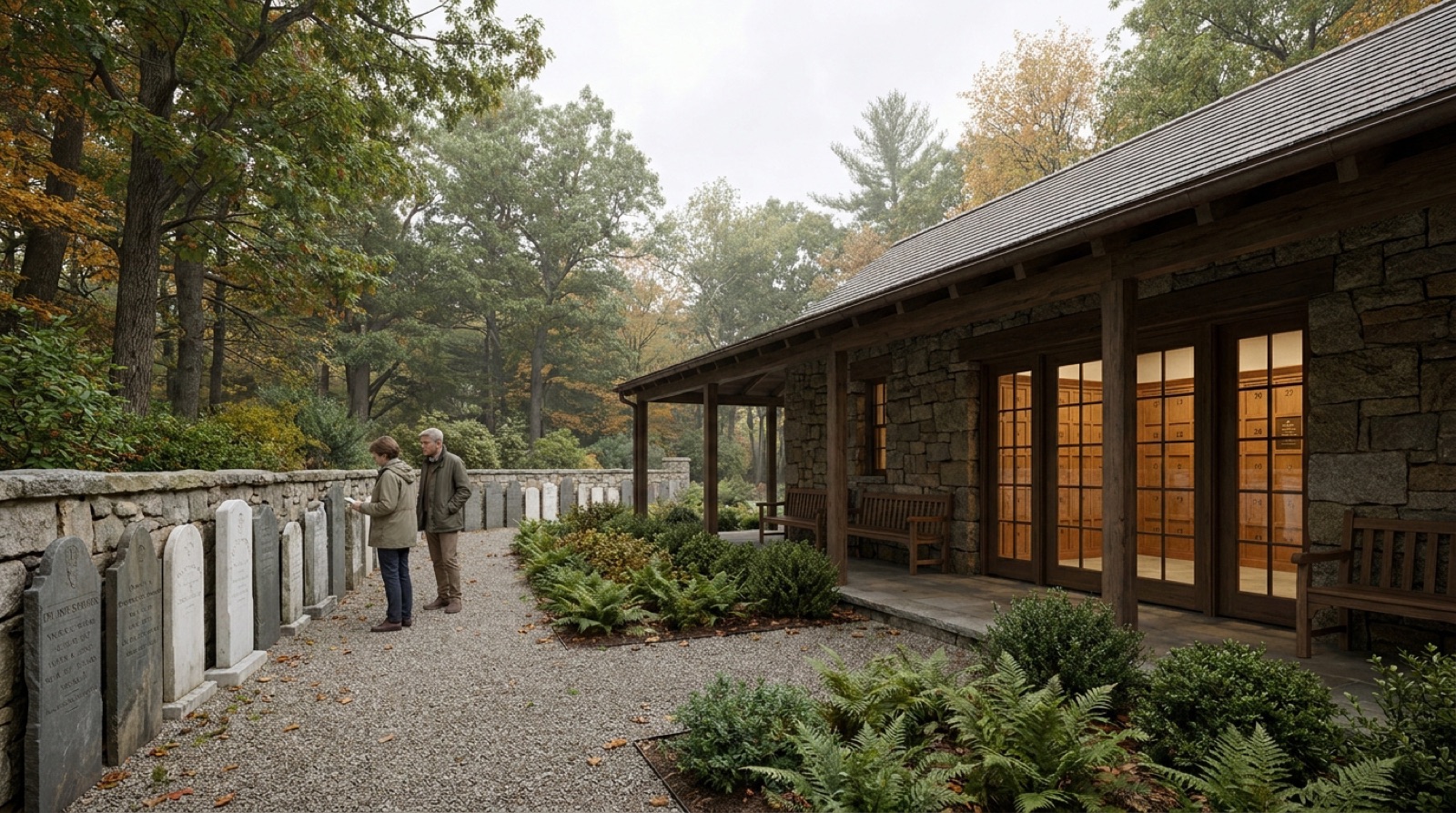
Graves nobody claims get two years of public notice and letters to known descendants. Then an archaeologist-supervised crew moves each person into an individual, labeled ossuary box in a memorial hall on the same grounds. Every headstone is kept. Every name is recorded.
Give the land back.
Freed land goes to public park first and homes on the edges. The tax pays for the moves before it pays for anything else.
The life of a grave under the 75-year rule
Years since burial
Someone pays
A family, a church, a historical society or a fan club pays the grave's share. The grave stays exactly where it is for as long as someone keeps paying.
No one claims it
- Two years of notice
- A careful, recorded move
- A labeled box in the memorial hall
- The land goes to the living
How a move works
Every step already exists in law somewhere
Notice
Letters to known descendants, a sign at the grave, a public list online and in the paper. Two years to answer.
As in South Australia, which waits at least two years.The family decides
Pay to keep it, move it to a family plot elsewhere, take the remains home after cremation, or let it go to the memorial hall at no cost.
As in Swan Point's own rules, which already allow removals.The move
A licensed crew with an archaeologist and a health officer. Early morning, behind screens. Clergy of the person's faith when it is known.
As in England's exhumation licence and HS2 at Euston.Rest
Each person goes into an individual labeled ossuary box, placed in a memorial hall on the same grounds, with a service.
As in New South Wales and South Australia.Remember
The headstone goes on a memorial wall or stays as a marker. Name, dates and new location go into a public registry.
As in RIGL 23-18-11.2, which already requires both.
Two guardrails:
Faith comes first.
Jewish law forbids moving the dead except in narrow cases, and many Muslims hold that a grave should not be disturbed. Those graves stay put, with the congregation paying the share. Berlin already lets Jewish cemeteries keep permanent rest.
Start with the rich.
Past removals hit the poor. In 1964 Providence moved 4,355 North Burial Ground graves for I-95, mostly poor people and people of color, most of them into a mass lot, and kept no records for about three quarters of them. This plan starts with the most valuable private cemeteries. Swan Point alone holds 97% of Providence's tax-exempt cemetery value.
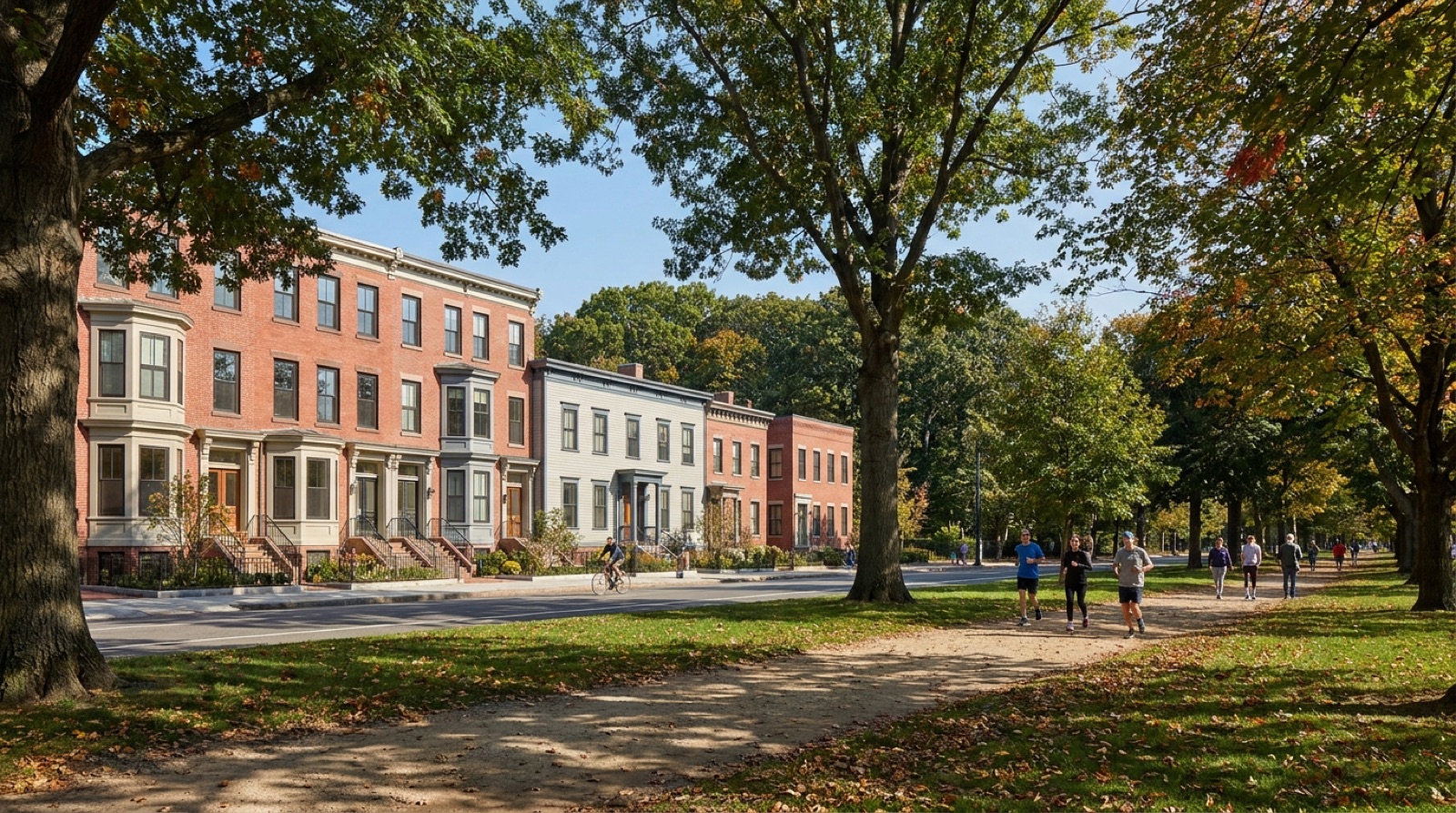
The space math makes this easy. By my math, all 40,000 people at Swan Point would fit in a memorial hall smaller than one acre. In practice most of the cemetery would stay: recent graves, claimed graves, the historic core and the notable monuments. And the aerial shows something better: about 21 acres of woods along Blackstone Boulevard with no grave sections at all. About 650 homes could go there without moving a single grave. The rest becomes about 108 acres of riverfront park and 28 acres of public woods.
The plan, drawn on the real aerial
Swan Point's 199 acres, Blackstone Boulevard to the Seekonk River
- 108 acriverfront park, open to everyone
- 28 acpublic woods, kept as forest with trails
- 42 acgraves kept, plus a memorial hall for everyone moved
- 21 acabout 650 homes on woods along the boulevard
Today, and one way it could look
Left: real aerial · Right: AI concept made from it
 TodayConcept
What could be built there
AI concept renderings · not designs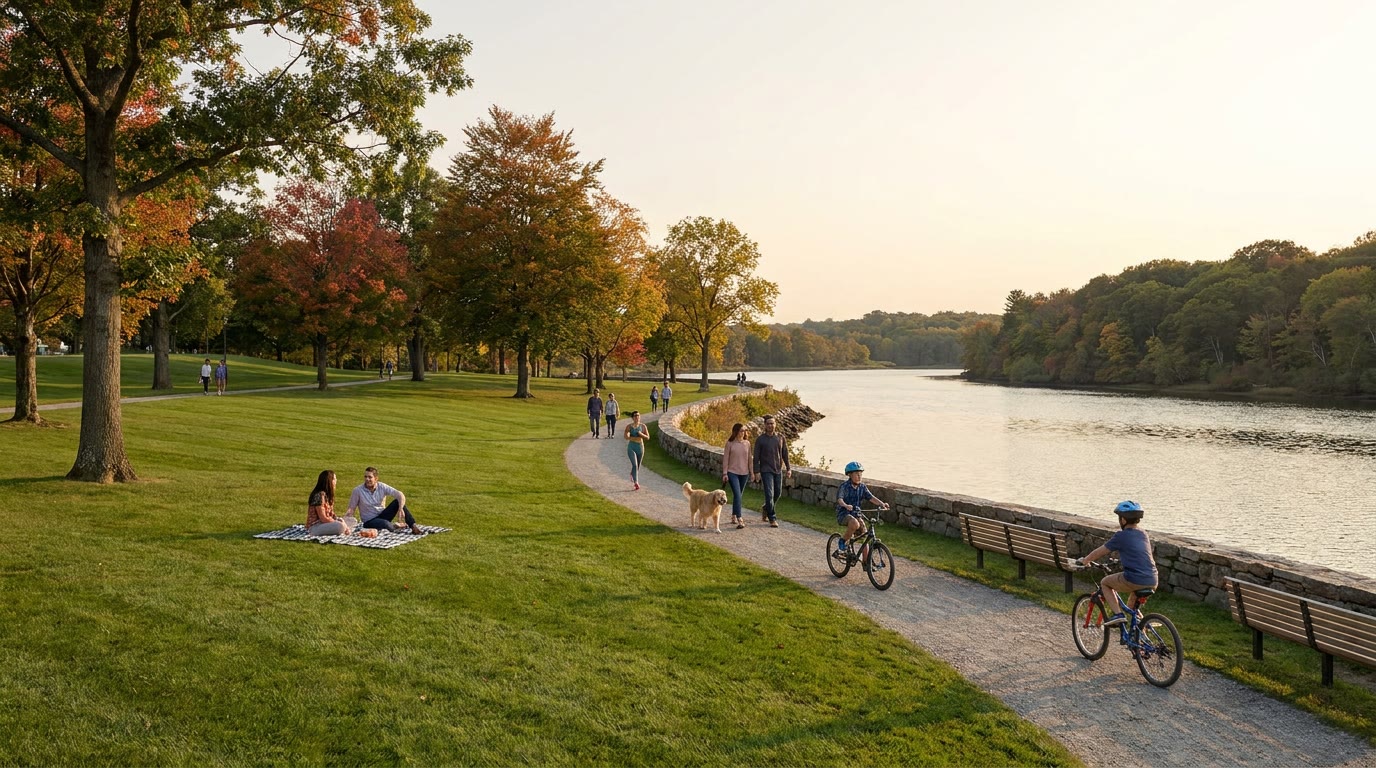
What the living get
Both outcomes are good for the city. If Swan Point keeps its land, it pays about $6.9 million a year. If it releases land under the 75-year rule, Providence gets about 108 acres of riverfront park, 28 acres of public woods and about 650 new homes. Those homes would pay about $3.5 million a year in property tax if they pay what the average condo near Swan Point pays today, $5,365.
| Swan Point keeps its land | Swan Point releases land | |
|---|---|---|
| Property tax a year | $6.9Mfrom the cemetery | ~$3.5Mfrom about 650 new homes, plus grave shares people choose to pay |
| New public land | none | ~136 acres108 of riverfront park, 28 of woods |
| New homes | none | ~650on 21 acres of woods along Blackstone Boulevard; the city permitted 778 in all of 2025 |
| For the schools | 67 teachersbase pay for every teacher facing layoff | 36 teachersbase pay at the top of the scale, every year |
Swan Point can afford it
Swan Point's endowment is $147 million. In 2024 it earned $15.6 million on its investments, more than twice the tax bill. So the cemetery has a choice. It can keep every grave and pay its taxes out of investment returns, and the city gets $6.9 million a year. Or it can release land it no longer needs, and the city gets a park and homes. Either way the living come out ahead.
Swan Point's 2024 investment earnings vs. its tax bill
Millions of dollars · IRS Form 990, 2024
Who the endowment serves
Nobody owns Swan Point. Its stockholders were bought out in 1858, and as a nonprofit it pays no dividends. So the fair question is who its $147 million actually serves. The 2024 tax filing answers it.
Half of Swan Point's spending is pay and benefits
Where $5.45 million went in 2024 · IRS Form 990, Part IX
- Today's buyers of graves. Sales brought in $3.6 million against $5.45 million of costs. The fund covers the gap, so every new burial is sold below cost.
- The staff and the board. Pay and benefits were $2.8 million, half of all spending. The directors were paid $138,750 between them, for what the filing lists as one to nine hours a week each.
- Lot owners. Their lots are mowed forever, and they elect the board.
- The fund itself. In 2024 it spent about 1% of its value and earned about 12%. From 2010 to 2024 it earned $114 million and drew down $28.5 million.
- Not the city. Providence collects nothing.
What the staff are paid
These are the figures Swan Point reports to the IRS. The top three staff each earn more than twice the median Providence household's income of $66,772.
| Role | Hours a week | 2024 pay |
|---|---|---|
| President | 42 | $248,978 |
| Treasurer and director of finance | 45 | $148,017 |
| Director of grounds operations | 35 | $145,524 |
| Board chair | 9 | $59,250 |
| Other directors (9 over the year) | 1–2 each | $79,500 total |
| Secretary | 1 | $11,750 |
| Everyone else (about 37, incl. seasonal) | varies | ~$42,000 avg. |
The objections
- "It's disrespectful."
- Respect is memory and care. Under this plan every person is handled individually, every name is kept and every family is asked first. The disrespectful version is what Providence did in 1964. Ethicists who study this, like Julie Rugg and Stephen Holland at the University of York, argue that reusing very old graves does the dead no serious harm.
- "Families bought those plots forever."
- They bought a right to be buried and perpetual mowing. Both survive. The tax exemption comes from state law and from Swan Point's charter, and the legislature reserved the right to amend both before Swan Point existed. It used that same power on hospital and college charters in 2023.
- "It's already green space."
- Then let's make it a real park, open after 5pm, with dogs and picnics and kids on bikes.
- "It's history."
- Keep the history. Swan Point is on the National Register, and a park can keep its Victorian landscape, its ponds and its notable graves. Lovecraft's fans bought his headstone in 1977. They can cover his $170.
- "Cremation will fix it."
- It helps. Cremation is now above 60% nationally and is projected to reach 82% by 2045. That also means fewer burials paying for cemeteries and more empty land held tax-free for burials that are not coming.
What it would take
In Rhode Island: a general law that any city or town can adopt, because the Supreme Court ruled in 2026 that a Providence-only act needs a city referendum. It would narrow the burial-ground clause in RIGL 44-3-3, override Swan Point's "forever exempt" charter clause the way the legislature overrode hospital and college charters in 2023, and amend RIGL 23-18-11.1, which only allows moving a historic cemetery when there is "no prudent or feasible alternative," so that a supervised, recorded move under this program qualifies. In New York: amend Real Property Tax Law section 446.
And New York is the same story, bigger
New York City has 3,916 acres of cemetery, about 2% of the city's land and 4.6 times the size of Central Park. Queens alone has 1,880 acres of it. The rental vacancy rate is 1.4%.
New York City's cemeteries, measured in Central Parks
3,916 acres of cemetery tax lots, PLUTO 2026
The city values cemetery land as cemetery, about $508,000 an acre, so the exemption costs it roughly $90 million a year on paper. Value that land like the development sites next door and the forgone tax is closer to $1.6 billion a year (my mid estimate). New York even exempts empty land a cemetery holds in reserve for future burials.
Put homes on a quarter of the city's private cemetery land at the density planned for Sunnyside Yard (67 homes per acre, parks included) and you get about 63,000 homes. The City of Yes zoning reform is expected to add about 82,000 over 15 years. The other three quarters would add about 2,800 acres of park, more than three Central Parks.
The dead deserve to be remembered. They do not need 199 acres of the East Side to do it.
Either the dead pay rent, or they make room. Both are good for the living.
Sources and math
Swan Point
- Acreage, owner, assessed value: City of Providence assessor parcel layer (Plat 38 Lot 81, 199.13 acres) and 2025 Property Tax Roll ($235,599,000, exempt). Parcel layer.
- History, Olmsted western section, 36,000 graves in 1977: National Register nomination; Swan Point history (moved burying grounds, 1946 house lots). "About 40,000" today is a secondary figure.
- Rules: visitor etiquette; hours; lot terms; notable people.
- Finances: IRS Form 990s for 2013–2024 via ProPublica. Endowment $147.2M at the end of 2024, up from $74.4M at the end of 2012; investment earnings including unrealized $15.64M in 2024. Sales of graves and services have been below total expenses every year since 2011.
- Spending and pay: 2024 Form 990, Part IX (functional expenses), Part VII and Schedule J. Endowment draws and earnings: Schedule D, Part V, 2010–2024.
- Aerial: USDA NAIP imagery via the USGS National Map. Condo taxes: 2025 Property Tax Roll, plats 37–42, "Residential Condo" (271 parcels, average assessment $542,670, average tax $5,365).
- Per grave: 199.13 ac × 43,560 ÷ 40,000 = 217 sq ft. Tax per grave: $6,879,491 ÷ 40,000 = $172. River frontage (~0.9 mi) measured on the city parcel map against OpenStreetMap's shoreline.
Providence
- Exemption: RIGL 44-3-3(a)(11), dating to G.L. 1896. Moving historic cemeteries: RIGL 23-18-11.1 and 23-18-11.2.
- Tax rates, the $635.8M budget and the $152,243,705 school appropriation: FY2027 Adopted Ordinance Book.
- Schools' $16.5M deficit and 109 possible layoffs, 67 of them teachers: NBC 10, May 14, 2026. Teacher base pay $50,782–$95,722: Boston Globe, June 2025.
- Brown: "nearly $175 million over 20 years".
- Population 195,310: Census Vintage 2025. Land 18.406 sq mi = 11,780 acres (2020 Gazetteer).
- Parks: city Parks and Open Space layer, about 1,213 acres including North Burial Ground and Locust Grove, about 1,093 without.
- Park per resident: 1,093 × 43,560 ÷ 195,310 = 244 sq ft. Swan Point vs. parks: 199 ÷ 1,093 = 18%, or 16% counting city cemeteries as parks. All cemeteries in the city: about 345 acres, summed from assessor parcels.
- Housing: RI 2025 Integrated Housing Report (778 units permitted in Providence, 48% of renters cost-burdened, median value $362,200, up 60.8% since 2020).
- 1964 I-95 removals: Providence Preservation Society. Cemetery share of exempt value (97% Swan Point): computed from the 2025 roll; see also Providence on the Record.
Rhode Island law and the charter
- Swan Point's charter: Acts and Resolves, May Session 1858, pp. 44–47 ("forever exempt from all taxes and assessments"), re-enacted in January Session 1902, pp. 240–242; construed in Swan Point v. Tripp, 14 R.I. 199 (1883).
- Reserved power to amend charters: Public Laws (1844), p. 65; Revised Statutes (1857), ch. 125, § 14; Tomlinson v. Jessup (1873).
- 2023 charter override for hospitals and colleges: P.L. 2023, ch. 325. Providence-only acts need a referendum: Myles Standish Associates v. Providence (2026).
- Statewide: 2,010 mapped cemetery acres (RIGIS 2020, class 163) × FHFA tract land values × a 0.20 / 0.42 / 1.0 large-tract factor, government land excluded, Providence at its actual roll value, × each town's FY2026 commercial rate = $9.8M / $12.8M / $20.8M a year.
New York City
- 3,916 acres, by borough: PLUTO 26v2, building class Z8. Share of land: ÷ 192,289 land acres (Census Gazetteer).
- Exempt value $867.4M (actual) / $818.2M (transitional): DOF exemption code 1700; class 4 rate 10.848%: NYC Finance.
- Forgone tax: $818.2M–$867.4M × 10.848% = $89–94M. At development land value ($4.4M / $8.7M / $20M an acre, from 2026 Queens site sales) × 3,762 private acres × 4.88% effective rate = $0.8B / $1.6B / $3.7B.
- Exemption law: RPTL §446, including reserve land.
- Vacancy 1.41%: 2023 Housing and Vacancy Survey. City of Yes ~82,000 homes: NYC Planning. Sunnyside Yard, 12,000 homes on 180 acres: Architect's Newspaper.
- Homes: 3,762 × 25% × 67 = 63,000. Park: 3,762 × 75% = 2,822 acres ÷ 30,456 NYC Parks acres = 9.3%.
- Hart Island: NYC Parks; first public tours, NY1, Nov 2023. Washington Square, ~20,000 burials: NYC Parks history.
San Francisco, Chicago and the US
- Burial ban (1900), 1.5 million dead and 1,509 living: Town of Colma. Ban upheld in Laurel Hill Cemetery v. San Francisco, 216 U.S. 358 (1910).
- Chicago's Lincoln Park as a former cemetery: American Society of Planning Officials, PAS Report 16 (1950).
- Cremation 63.4% (2025): NFDA; 82.3% by 2045: trade press summary.
- Closest existing US arguments: Oregon ORS 307.158 (2018) eases converting cemetery land to low-income housing; Daniel Haller, "Georgist Cemeteries" (2024).
Abroad
- Germany, average right-of-use 23 years: Aeternitas; Bastheim fee schedule. Berlin permanent rest for religious reasons: Berlin parliament.
- Berlin's 2006 plan, 290 of 1,037 ha: Senate Department.
- Sweden, 25-year default: Begravningslag 1990:1144; burial fee: Skatteverket. Netherlands: Wet op de lijkbezorging.
- Singapore 15-year rule: NEA. Bidadari, 8,872 flats and a 10-ha park: URA; memorial garden: Roots.sg.
- Hong Kong niches, 20 years renewable: HK Government. Greece's ossuary rent is a secondary figure.
- London reuse after 75 years: London Local Authorities Act 2007 s.74. Law Commission, March 2026: recommendations.
- HS2 and Brookwood: HS2. NSW renewable rights and ossuary boxes: Cemeteries & Crematoria NSW. South Australia's two-year notice: Adelaide Cemeteries.
- Ethics: Rugg and Holland, "Respecting corpses: the ethics of grave re-use", Mortality (2017). Surplus cemetery land in Central Europe: Säumel et al. (2023).